The offer price of a Robusta lot does not simply track the London market. Where the year sits in the crop cycle, moisture after drying and how much farmers are still holding all move the differential, and they move week by week.
The shape of a crop year
The Robusta crop in Dak Lak, Gia Lai and Lam Dong is harvested from November to January. After picking come drying, hulling and grading, so goods reach the port mainly between February and April. In that window availability is at its highest and buyers have the widest choice of screen size.
From May onwards supply depends on how much farmers and traders have held back waiting for a better price. High screens such as Screen 18 run out first, lower screens last longer. That is why a quote request for Screen 18 in August usually comes back with a noticeably higher differential than the same request in March.
Supply also differs by how the goods are bought. In areas where An Supply holds long-term linkage contracts with cooperatives, volume and delivery timing are predictable from the start of the crop. In areas bought through traders, volume follows the weekly price, so the delivery schedule is only firm once the lot is fixed. Buyers who need a committed monthly delivery should say so at the outset, so An Supply can choose a suitable source instead of promising a schedule it cannot hold.
Moisture after drying
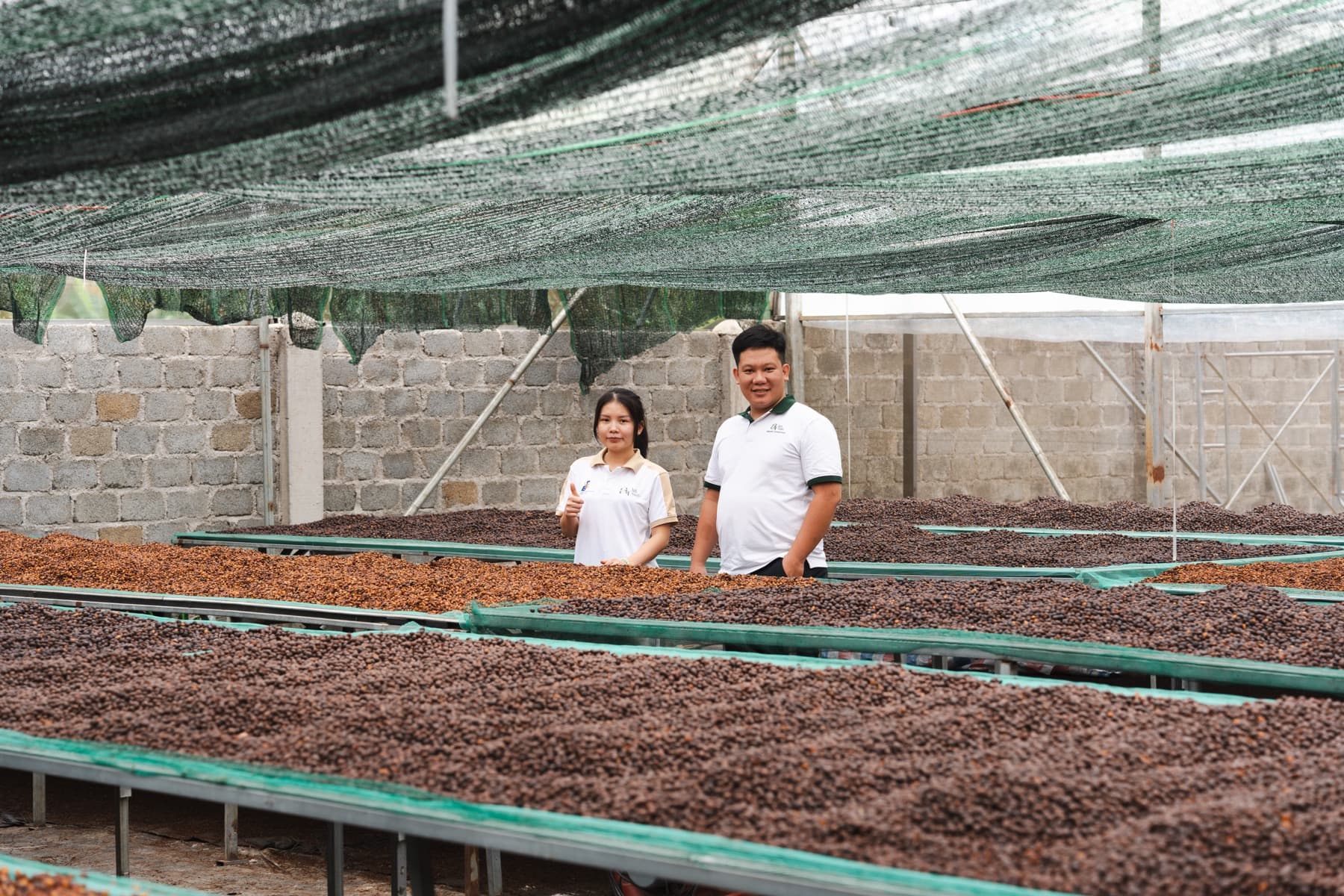
Moisture is easy to pass over in negotiation and it decides whether the lot is discounted at the destination port. The common commercial threshold is 12.5%. Coffee dried during late-crop rain often sits above that, and if it is bagged before it stabilises the moisture keeps moving inside the container.
- Lots on long routes, or shipping through the rainy season, should use a sealed liner inside the jute bag.
- Ask for a measured moisture report for the lot about to be packed, not the figure from the previous lot.
- If the contract sets a threshold tighter than 12.5%, raise it early: it affects both price and schedule.
Two kinds of moisture figure need keeping apart. A handheld meter at the warehouse gives a fast reading with a wide margin of error, useful for screening before goods are accepted. The figure that goes on the documents has to come from a laboratory method. When the two disagree, the laboratory figure is the one that counts in a dispute, so An Supply draws a sample and sends it for testing before the container is stuffed rather than relying on the warehouse reading.
Why the offer price changes weekly
An offer price has two parts: the London reference and the quality differential. Buyers follow the reference themselves. The differential moves with the volume actually available in the growing area, inland transport cost, and the delivery progress of contracts already signed.
The differential says more about the growing area than the number on the exchange does.
That is why every An Supply quote states the date it is valid for. Last week's differential no longer holds once supply in the area has shifted.
When to fix the contract
Buyers who need large, steady volume usually fix a whole-crop contract in late November, when the size of the crop is visible but the goods have not all come out. Buyers who can be flexible on screen size wait for February to April, when choice is widest. Buying out of season works, but expect a higher price and a screen size possibly one grade down.
For multi-container contracts the usual approach is to split the volume into several deliveries across the crop rather than shipping it all at once. The buyer pays no storage on goods not yet needed, and An Supply has time to select lots of the right screen size instead of gathering whatever makes up the tonnage. In exchange, every delivery means another inspection and another document set, so the paperwork cost per tonne is slightly higher.
The calendar for any given year depends on the weather and needs confirming by the sourcing team · [to be confirmed]